Faster Rollouts with MTP Speculative Decoding
MTP training requires the megatron backend and the vllm inference engine.
MTP traininng is currently experimental. We are actively working on benchmarking MTP in fully async, multi-turn RL scenarios as well as providing guidelines on when it is most useful.
In this example we train a model's native Multi-Token Prediction (MTP) head with a decoupled draft loss, and reuse that head for vLLM speculative decoding to speed up rollout. Because the draft loss is autograd-decoupled, it trains only the MTP head and never perturbs the policy, leaving the RL dynamics unchanged.
Source code: examples/train/spec_decode/.
Overview
During RL training, rollouts (generation) are typically the throughput bottleneck. Speculative decoding improves throughput (at lower batch size) with a small, cheap drafter that proposes the next k tokens, which the policy then verifies in a single forward pass.
Since the policy distribution changes in RL, the drafter must be co-trained to stay aligned. SkyRL trains the MTP heads with a top-k soft cross-entropy loss, which better aligns the drafter and policy distributions while reducing the memory overhead of training the additional heads.
There are two pieces:
- Training the head — a decoupled draft loss distills the policy's own next-token distribution into the MTP head on the Megatron backend.
- Drafting with it — the trained head is handed to vLLM as an MTP drafter. Every weight sync reloads it in vLLM's native draft session, right after the policy.
How does it work?
The draft loss reuses the hidden states the policy's forward pass already computed: it replays the MTP block on the detached trunk and trains the head against the policy's own detached next-token distribution. The loss is vocab-parallel, so it works under tensor parallelism.
Everything but the head is detached: trunk, re-embedding, output weight, and teacher. So the draft gradient reaches only the MTP head, never the backbone. The head shares the policy's gradient buffer and optimizer but is clipped by its own gradient norm.
Enabling MTP
trainer.mtp is the single high-level knob. It propagates to both the training side (Megatron MTP heads + draft loss) and the inference side (vLLM speculative_config):
trainer.mtp.enabled=true \
trainer.mtp.num_speculative_tokens=3 \
trainer.mtp.loss_weight=0.2
This requires an MTP-capable checkpoint — most recent models ship one. Training always trains the checkpoint's own heads. If the model resolves to zero heads, the run fails during model init rather than silently training without a drafter.
num_speculative_tokens is the vLLM draft depth, independent of the trained head count. Single-head checkpoints reuse the one head autoregressively at depths > 1 — more speedup, but acceptance decays with depth, since the head only trains at depth 1. Start at k=3 and tune with the per-depth metrics.
The draft loss is megatron backend only. trainer.mtp.enabled=true under trainer.strategy=fsdp will not build any heads.
Syncing the drafter requires the megatron backend and the nccl (default) or delta weight sync backend. Sharded RDT, serialized FP8 weight sync, and adapter-only LoRA (merge_lora=false) are rejected at config validation.
Configuration
The high-level knob:
| Field | Default | Description |
|---|---|---|
trainer.mtp.enabled | false | Train MTP heads and use them for speculative decoding. |
trainer.mtp.num_speculative_tokens | 1 | vLLM draft depth per step. |
trainer.mtp.loss_weight | 0.1 | Weight w of the draft loss in policy_loss + w * draft_loss. |
Megatron-side fields tune the draft loss; most runs only need mtp_loss_topk:
| Field | Default | Description |
|---|---|---|
mtp_num_layers | null | Head count. null honors the model's HF config; 0 force-disables MTP. |
mtp_loss_topk | null | Distill only the teacher's top-k tokens instead of the full vocab: O(seq*k) memory rather than O(seq*vocab). null uses the exact full-vocab loss. |
mtp_loss_chunk_size | 1024 | Sequence-chunk size for the draft loss, with gradient checkpointing, to bound peak memory. Numerically identical to no chunking; ignored when mtp_loss_topk is set. |
mtp_loss_weight | 0.1 | Set automatically from trainer.mtp.loss_weight. |
Example
Two complete examples in examples/train/spec_decode/, both on a single 8xH100 node:
| Script | Task | Model |
|---|---|---|
run_megatron_dapo_mimo_7b_rl_specdecode.sh | DAPO on dapo-math-17k | XiaomiMiMo/MiMo-7B-RL |
run_megatron_dapo_qwen3.5_9b_specdecode.sh | DAPO on dapo-math-17k | Qwen/Qwen3.5-9B |
The MTP-specific parameters are:
MTP_ENABLED=true
MTP_NUM_SPECULATIVE_TOKENS=3
MTP_LOSS_WEIGHT=0.2
MTP_LOSS_TOPK=256

uv run --isolated --extra megatron -m examples.train.algorithms.dapo.main_dapo \
    trainer.strategy=megatron \
    trainer.mtp.enabled=$MTP_ENABLED \
    trainer.mtp.num_speculative_tokens=$MTP_NUM_SPECULATIVE_TOKENS \
    trainer.mtp.loss_weight=$MTP_LOSS_WEIGHT \
    trainer.policy.megatron_config.mtp_loss_topk=$MTP_LOSS_TOPK \
    generator.inference_engine.backend=vllm \
    ...
To run it (from the SkyRL root directory):
bash examples/train/algorithms/dapo/prepare_dapo_data.sh
export WANDB_API_KEY=<your_key_here>
bash examples/train/spec_decode/run_megatron_dapo_mimo_7b_rl_specdecode.sh
Monitoring acceptance
Acceptance determines your speedup. It is logged under vllm/train/:
draft_acceptance_rate— accepted / drafted tokens.draft_mean_acceptance_length— tokens produced per target forward pass. This is the speedup factor: 1.0 means no gain,k+1is the ceiling.draft_acceptance_rate_pos_{1..k}— per-depth breakdown.draft_num_draft_tokens,draft_num_accepted_tokens— raw counts.
The draft loss is logged as mtp_loss on the training side.
Watch the per-depth breakdown when tuning k: acceptance decays with depth, so a low draft_acceptance_rate_pos_k means k is too deep for your model.
Results
We evaluate a DAPO run of Qwen3.5-9B against a baseline with speculative decoding disabled. The runs differ only in the MTP switch.
Setup. Single 8xH100 node. Training: Megatron TP=4, PP=1, CP=1, bf16. Rollout: 8 vLLM engines (round-robin router), depth-3 speculative decoding. DAPO on dapo-math-17k, AIME-2024 eval, 32 prompts x 8 samples/step, max_generate_length=8192.
Rollout throughput
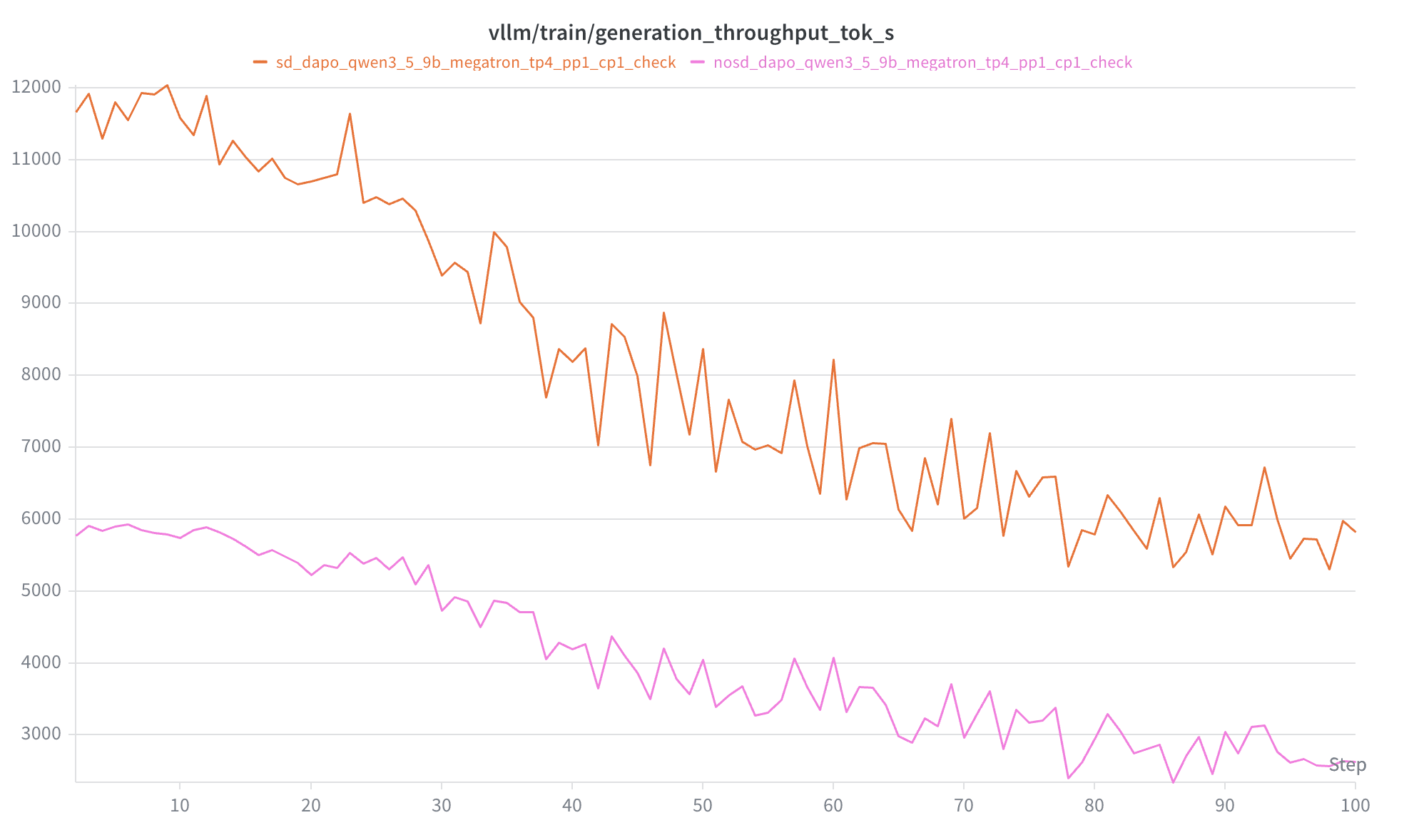
Speculative decoding roughly doubles generation throughput in rollout:
| Phase | Baseline | MTP | Speedup |
|---|---|---|---|
| Total step | 400.7 s | 246.8 s | 1.62x |
| Rollout | 310.1 s | 152.4 s | 2.03x |
| Policy train | 57.3 s | 61.3 s | 0.93x |
Rollout is 2.03x faster; at ~77% of the step, that gives a 1.62x step speedup. Draft acceptance was 77.3%, with a mean accepted length of 3.32 tokens (88.6/77.0/66.3% at depth 1/2/3).
No effect on policy training
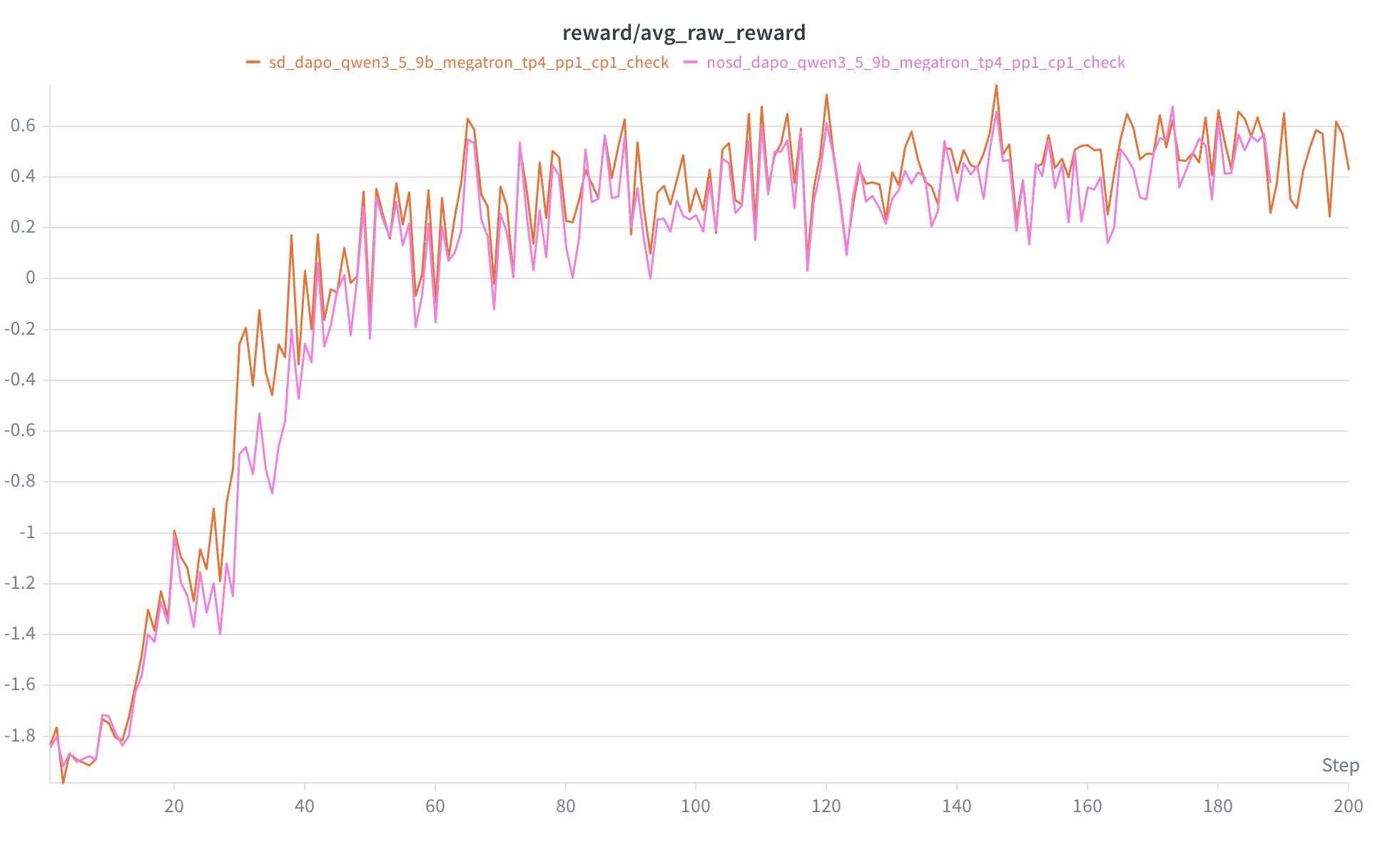
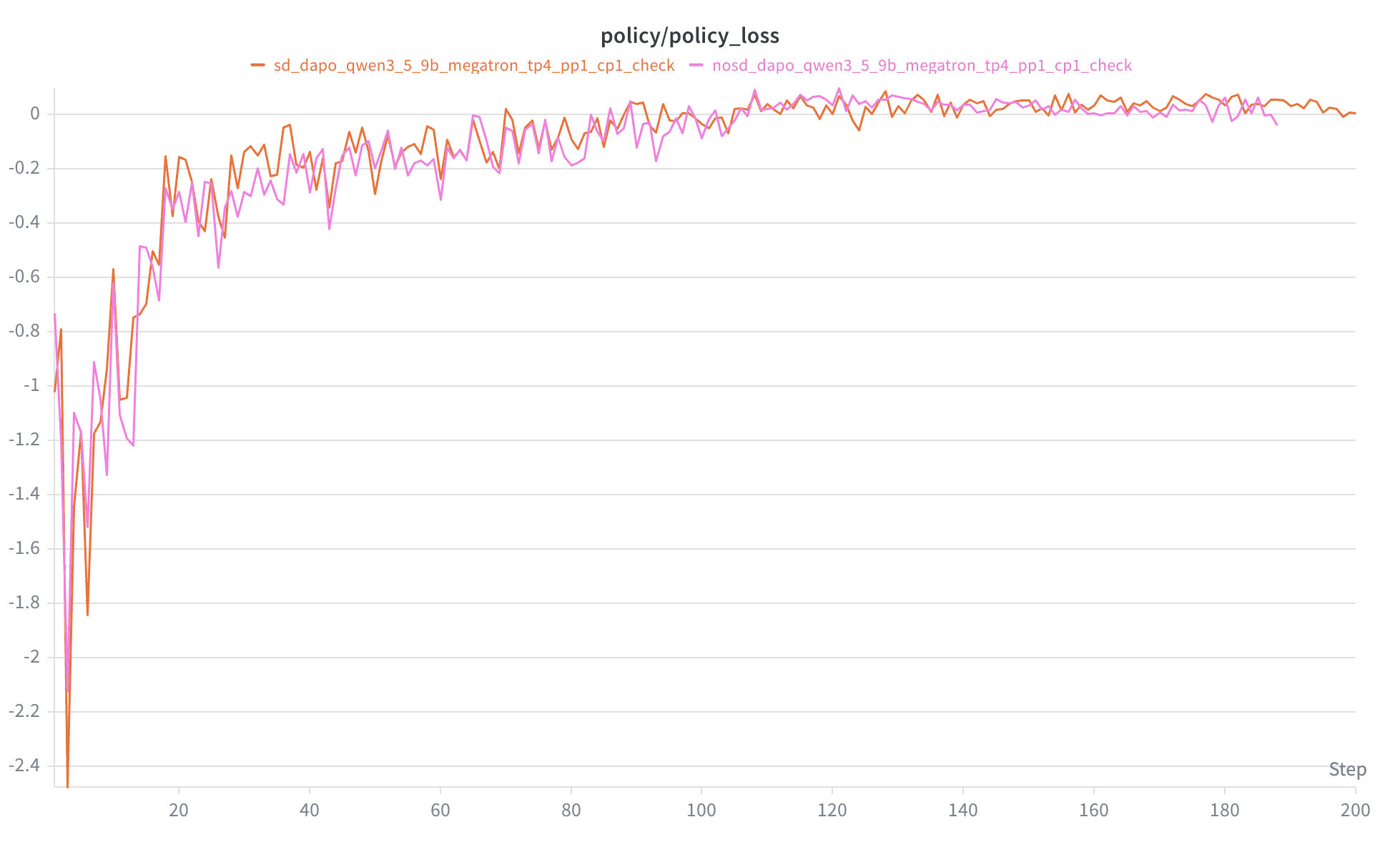
Reward and policy loss track the baseline, differing only by the run-to-run noise of independent runs. test_mtp_grad_isolation asserts the gradient isolation directly in CI.
Small training overhead
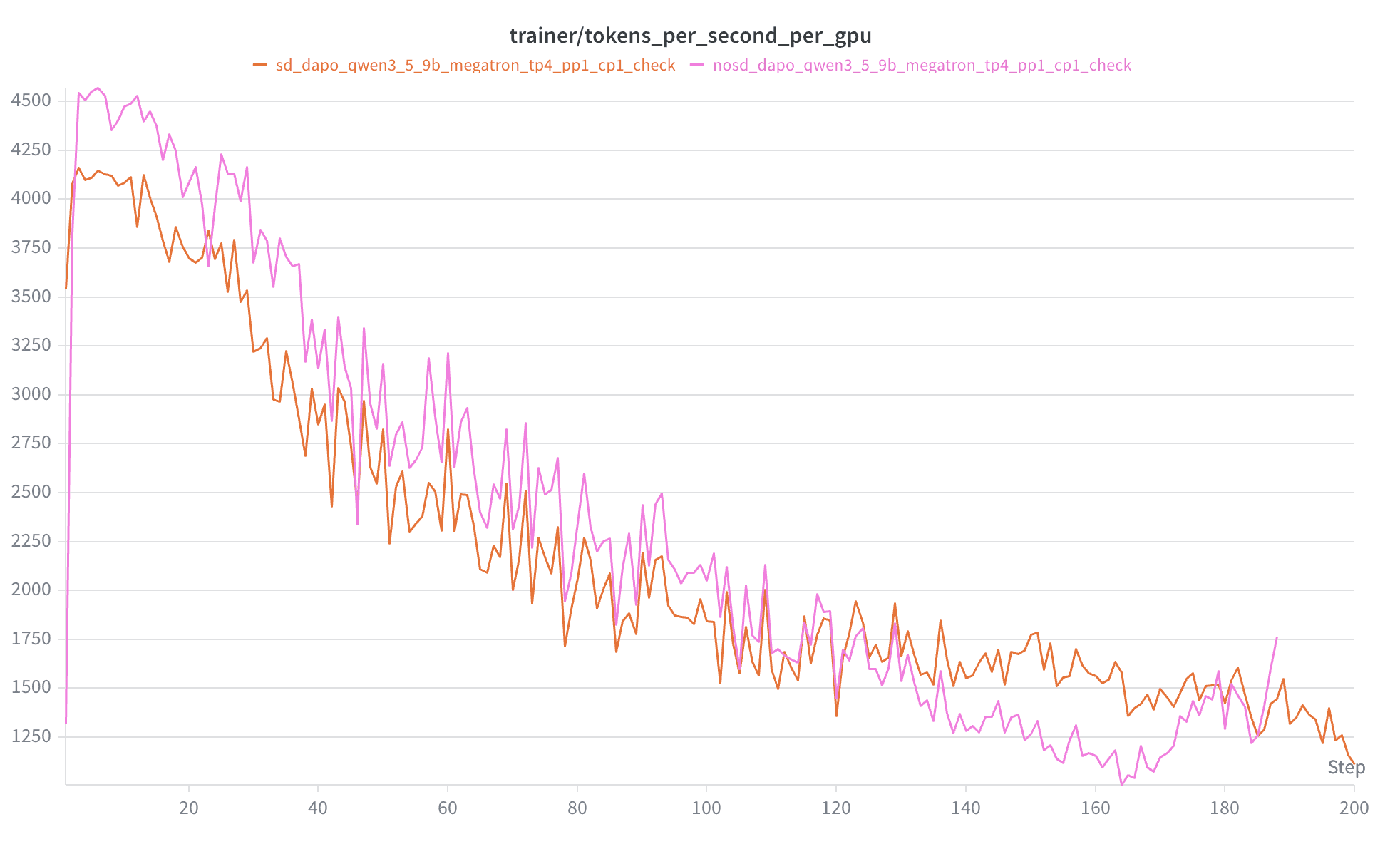
The MTP head adds ~7% to the train phase (57.3 → 61.3 s/step), easily paid for by the 2x rollout speedup.
What's Next
Native MTP heads are the first drafter SkyRL supports. We're working on broader drafter support:
- DFlash
- DSpark
- EAGLE-3
- Dynamic draft length