Inkling2
| Model | Full FT | LoRA | MXFP8 | Min. hardware |
|---|---|---|---|---|
| Inkling-2-Small | ✅ (4x8 B200) | ✅ (4x8 B200) | MXFP8 rollouts | 4x8 B200 |
| Inkling-2-Small-MXFP8 | ✅ (4x8 B200) | ✅ (4x8 B200) | MXFP8 rollouts | 4x8 B200 |
SkyRL has Day 0 support for Inkling2, Thinking Machines' ~594B-parameter MoE (~17B active): full fine-tuning and LoRA, with BF16 or MXFP8 rollouts. The examples run DAPO on DAPO-Math-17K and evaluate on AIME24 and AIME25.
Inkling2 support lives on the inkling2-support branch
(#2730) until a vLLM release ships the model. The branch pins vLLM to a
build of the Inkling2 vLLM branch
(torch 2.14, CUDA 13, x86_64), which replaces SkyRL's vLLM for every model in that environment.
The model
- Attention: 48 layers of sliding-window attention (window 1024) with a global attention layer every sixth layer, all with a learned relative-position bias.
- Block attention residuals: each sub-layer reads a learned mixture of earlier block outputs instead of a single residual stream.
- Short convolutions on the attention and MLP paths.
- MoE: 384 routed experts, top-8, sigmoid router with a selection-only bias.
- Precision: the releases ship the routed experts in NVFP4 (
Inkling-2-Small) or MXFP8 (Inkling-2-Small-MXFP8). Megatron trains them in BF16 (dequantized on import), and vLLM serves them in BF16 or MXFP8, quantized from the synced BF16 weights.
Setup
The examples run on 4 nodes of 8x B200 connected with InfiniBand, launched from the head node of a Ray cluster that spans them. Check out the branch:
git clone -b inkling2-support https://github.com/erictang000/SkyRL.git && cd SkyRLThe scripts are in
examples/train/models/thinkingmachines/inkling2/,
and all commands run from the repo root. uv run installs the pinned vLLM build.
Model and data. Download both to the same path on every node (node-local storage or a shared filesystem):
# NVFP4 routed experts, ~390 GB (or thinkingmachines/Inkling-2-Small-MXFP8, ~620 GB)
hf download thinkingmachines/Inkling-2-Small --local-dir /path/to/models/Inkling-2-Small

# writes dapo-math-17k-cleaned.parquet, aime-2024-cleaned.parquet and aime-2025-cleaned.parquet
DATA_DIR=$HOME/data/dapo bash examples/train/algorithms/dapo/prepare_dapo_data.sh
The scripts read MODEL_PATH (default thinkingmachines/Inkling-2-Small) and DATA_DIR (default $HOME/data/dapo).
Either release works as is: Megatron and vLLM dequantize the routed experts to BF16 as they load, and the release's own
chat template is used.
Configurations
| Configuration | Hardware | Placement | Script |
|---|---|---|---|
| Full FT (MXFP8 or BF16 rollouts) | 4x8 B200 | colocated | run_dapo_inkling2_fullft_colocated.sh |
| LoRA | 4x8 B200 | colocated | run_dapo_inkling2_lora_colocated.sh |
Both scripts share these settings:
- GRPO advantages, token-mean loss and the DAPO overlong penalty over the last 2,048 tokens of a 4,096-token response budget
- 128 prompts x 8 responses per step in mini-batches of 32
- reasoning effort
0.1(Inkling2's chat template takes areasoning_effortbetween 0 and 1; the scripts pass it viagenerator.chat_template_kwargs) - eval on AIME24 and AIME25 every 5 steps, four samples per problem
Full FT
LR 1e-6. Megatron (TP2 with sequence parallelism, EP32) and four vLLM engines (TP8) share all 32 GPUs and take turns:
vLLM sleeps while Megatron trains, and Megatron is offloaded while vLLM generates.
MODEL_PATH=/path/to/models/Inkling-2-Small \
  OPTIMIZER_STATE_DIR=/local/nvme/skyrl_optimizer_state \
bash examples/train/models/thinkingmachines/inkling2/run_dapo_inkling2_fullft_colocated.sh- Optimizer state off the GPU. The FP32 master weights and Adam moments (~138 GiB per GPU) stream through the GPU in
chunks during each optimizer step.
OPTIMIZER_STORAGE=host(default) keeps as much as fits in page-locked RAM and the rest in files underOPTIMIZER_STATE_DIR, which should be a fast node-local disk. - Bounded-memory weight sync. The woken engines hold ~141 GiB per GPU, so the sync exports from the offloaded Megatron params and sends each vLLM worker only its own experts.
- MXFP8 or BF16 rollouts. With
ROLLOUT_EXPERTS=mxfp8(default) vLLM quantizes the synced BF16 experts to MXFP8 as they load;ROLLOUT_EXPERTS=bf16serves them in BF16 (slower generation, smaller rollout/train gap). - REINFORCE with R3, sample-support replay and score centering (all on by default): vLLM returns each token's experts and the trainer routes through them; rollouts sample from top-p 0.95 within top-k 64 and the trainer scores the same support; and score centering subtracts each token's expected score under the sampler, cancelling the drift the remaining rollout/train mismatch adds. This is the "MXFP8 + score centering + top-p" run in the results.
LoRA
Rank-128, alpha-32 adapters on all linear layers, keeping the base model frozen, trained with clip-higher
(0.2 / 0.28). The routed experts use rank 16
(rank / top-k), with a separate adapter per expert (SHARE_EXPERT_ADAPTERS=false). LR 2e-5. Megatron (TP2, EP32) and
four vLLM engines (TP8) share all 32 GPUs, as in full FT; only the adapters are synced, in memory. Megatron's frozen base
weights are offloaded to node-local disk (SKYRL_FROZEN_OFFLOAD_DIR) while vLLM generates.
MODEL_PATH=/path/to/models/Inkling-2-Small \
  bash examples/train/models/thinkingmachines/inkling2/run_dapo_inkling2_lora_colocated.sh
Results
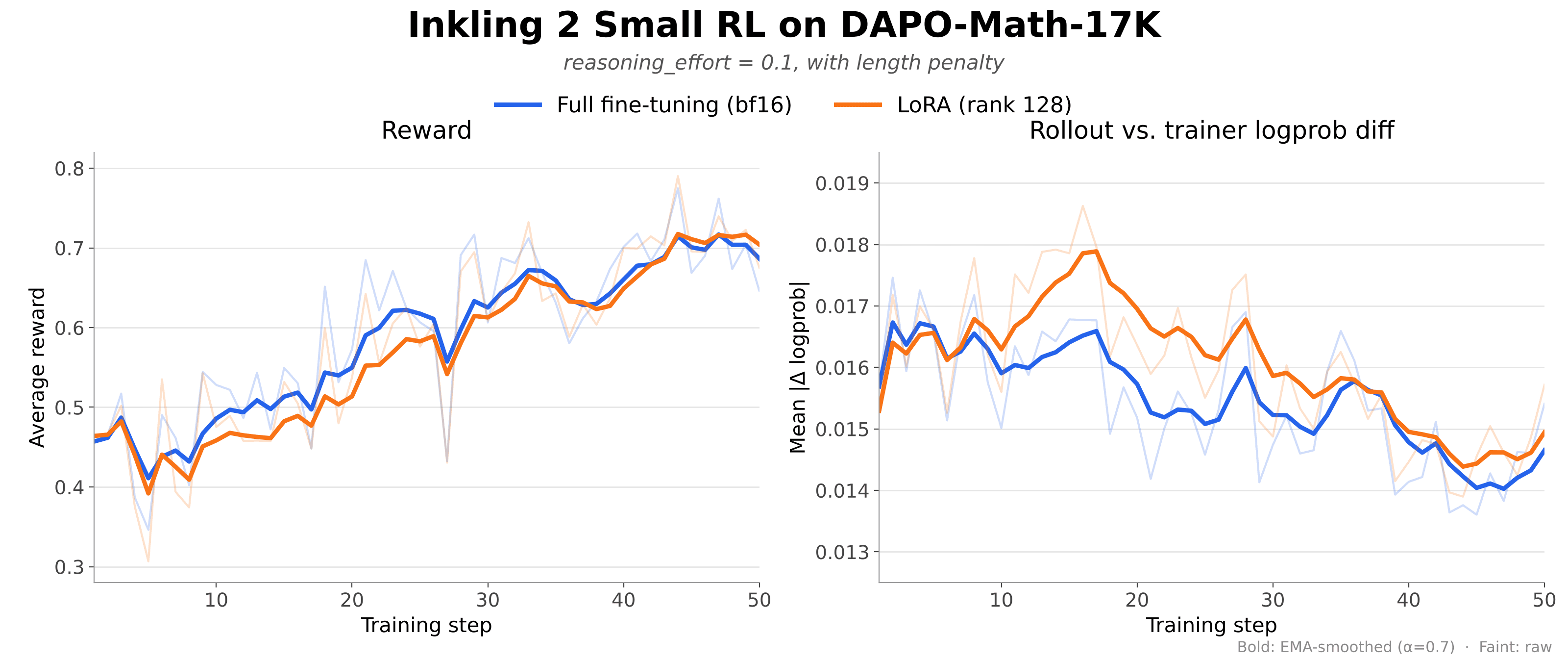
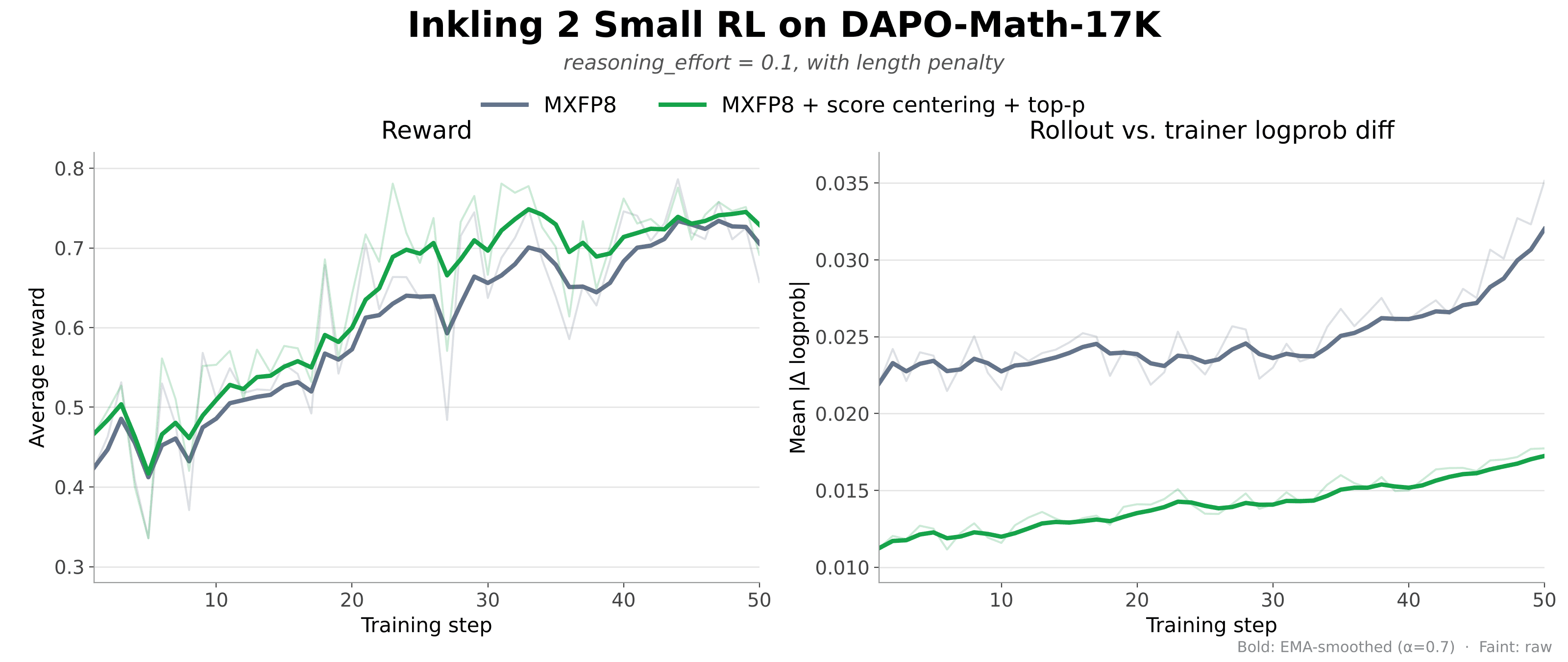
Inkling-2-Small on DAPO-Math-17K at reasoning effort 0.1 with the length penalty, 50 steps. Bold lines are EMA-smoothed, faint lines raw.
Full FT (BF16 rollouts) and LoRA. The LoRA curve is rank 128 (experts at rank 16), the script's default, not rank 32. Both raise the train reward from ~0.46 to ~0.70, and the rollout/trainer logprob gap stays around 0.014-0.018.
MXFP8 rollouts. MXFP8 alone reaches the same reward, but its logprob gap starts at ~0.022 and grows past 0.03. Score centering with top-p sampling cuts the gap roughly in half (0.011-0.017) and learns slightly faster.
Known limitations
- No pipeline or context parallelism in Megatron.
- The rollout/train gap still grows over long runs; consider adding an off-policy correction (TIS or masking) beyond ~50 steps.
How it works
- Megatron-Bridge. SkyRL adds an Inkling2 bridge with custom megatron-core modules for the block attention residuals, the relative-bias attention (FlexAttention), the short convolutions and the softcapped SiTU-GLU experts, checked against a plain PyTorch reference.
- vLLM. A
vllm.general_pluginsentry point serves the model through SkyRL'sInkling2ForRL, which takes the BF16 weights the trainer syncs (in any subset, in place, so CUDA graphs stay valid) and serves the experts in BF16 or MXFP8. - Weight sync. Both scripts sync over CUDA IPC on the shared GPUs. Full FT exports from the offloaded Megatron params and sends each vLLM worker only its local experts; LoRA sends only the adapters, each worker's slice of the expert adapters.